SHRINKAGE PREDCITION WITH AI
Masters Dissertation | GANN based Shrinkage Prediction for 3D printing in Architecture
A framework focusing advancing shrinkage prediction for optimal dimensional accuracy & manufacturing in 3D Printing.

Project Level : Academic Project
Project Type : Individual Design Project
Location : London, United Kingdom
Duration : Masters Project (June-Sept,2023)
Project Guide : Professor Sean Hanna
Technical Guide : Marcin Kosicki

This research aims to extend the work on predicting deformation in clay 3D printing by adapting the methods from the previous researches. Specifically, the aim is to investigate how well a convolutionally-equipped cGAN can learn to predict the deformation of 3D printed clay objects when the geometries are in the form of binary occupied voxels. The research is also based on how the data is produced and processed to feed the machine learning model.
The outcomes of this research will support the optimization of 3D printing processes, inspire innovation in design potential, and enable the realization of the transformative potential of 3D printing across industries. This approach is not limited to clay but can also be extended to accommodate a variety of materials, such as polymers, resins, metals, ceramics, composites, and biomaterials.
Previous Research Works


01 - IAAC’s project used machine learning to predict deformation during 3D printing by employing a basic artificial neural network. It only forecasts deformation at specific points and relies on a limited set of input parameters (infill type and density/geometry type)
02 - Collaborative research by Advances in Engineering Materials, Structures and Systems used a GAN Pix2Pix model in an inverse design workflow to predict 2D cutout patterns for laminates from 3D deformation data. Providing both speed and accuracy improvements, particularly in early design phases.

Aim
The reserach explores how well the modified Vox2Vox model can predict deformation when changing geometry parameters to voxels. Unlike the 2D-focused Pix2Pix model, Vox2Vox is tailored for 3D voxels and overcomes parametric limitations, making it versatile for predicting deformation in various 3D geometries. This approach has potential applications beyond clay and could significantly impact architectural 3D printing.
The research methodology can be segmented into the six key phases.
1. Geometry exploration and Dataset generation

2. 3D Printing Clay using Robot


3. Scanning and Comparison

4. Synthetic Dataset generation


5. Binary Occupancy Voxelisation
6. Machine Learning model - Vox2Vox implementation
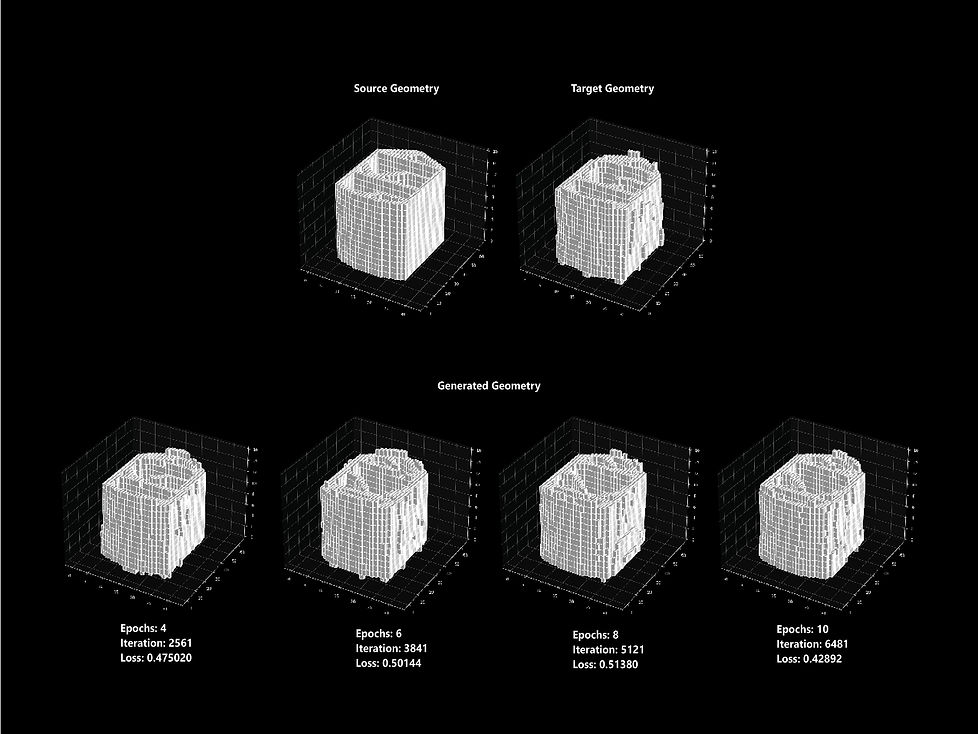
Four training sessions were conducted, each with a different number of epochs. The first training session comprised 4 epochs, the second used 6 epochs, the third utilized 8 epochs, and the fourth extended to 10 epochs. In all cases, a batch size of 1 was employed. Evaluations were conducted using a validation dataset after every 80th iteration. It’s worth noting that in this context, the number of iterations equates to the number of batches since the batch size was set to 1. At the conclusion of the process, line plots depicting the loss and accuracy are generated and saved.
32 Voxels
16
Voxels
64 Voxels

Loss and Accuracy Graph Analysis
10 epochs
Test Results

Source
Geometry
Target
Geometry
Generated
Geometry
A variety of different geometries were tested, and the results of the generated ones were depicted using the best model from the training.
The Vox2Vox cGANN framework has been validated for predicting clay object deformation, offering promise for designing 3D printed objects that account for post-deformation shapes. Understanding materials’ post-production deformation is valuable in manufacturing, construction, and materials science. This research has broader applications beyond clay materials, relevant to any substances with shrinkage or expansion properties.